Popote, Pajita, Sorbeto: Communicating Across Languages in New Jersey

Popote, Pajita, Sorbeto: Communicating Across Languages in New Jersey

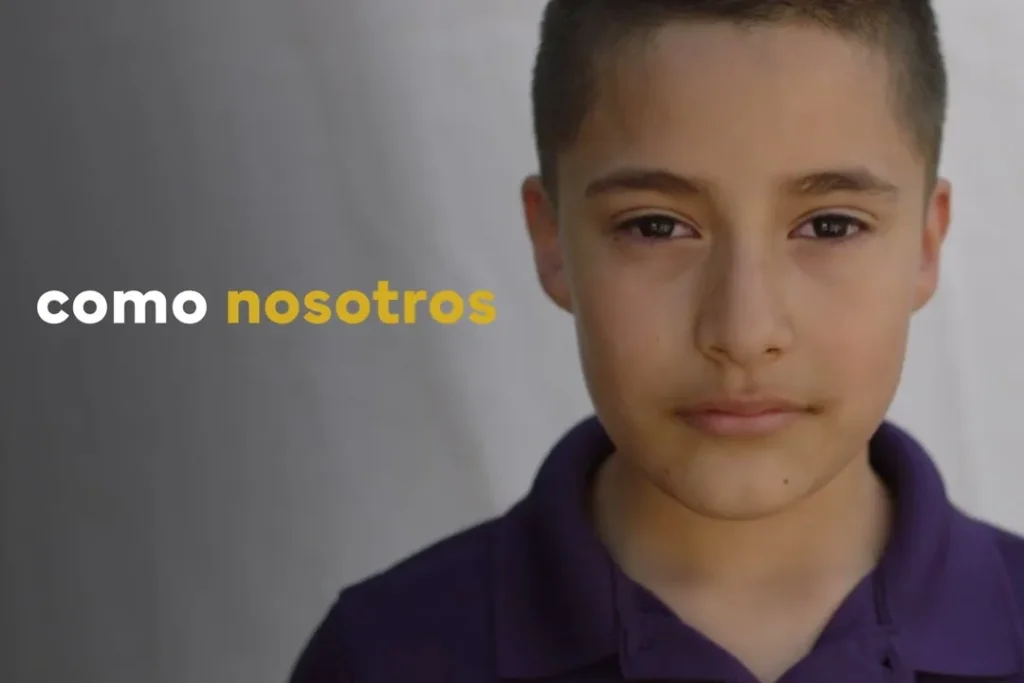
A boy in a purple shirt looks at camera, with the Spanish caption 'como nosotros'

What it takes to actually reach Latino voters — and how we proved it moved them.

Client Make the Road Action New Jersey · 2025
Partners Way to Win · INTRVL · creative by Moira Studio

The problem

Between 2020 and 2024, New Jersey’s presidential margin moved about ten points toward Republicans — from a 15.9-point Democratic win to a 5.9-point one. Democrats outspent Republicans two to one across that period. Whatever that money was buying, it was not reaching the people who moved.

For Latino-focused media the problem is sharper and more specific. As much as 70 percent of online ethnicity targeting misses. Surname targeting stopped working decades ago. Browser language settings are a crude proxy that misses most of the people they are meant to find. So campaigns spend real money on audiences that are substantially not who they think they are, and then draw conclusions from the results.

The approach

Two problems had to be solved at once: find the voters who could actually be moved, and reach them in the language they prefer.

This was a 501(c)(4) issue advocacy program. The advertising made a case about the economy and immigration — who holds responsibility for the cost of living, and who can be trusted on the issues these communities care about. It did not ask anyone to vote for or against a candidate.

Working with INTRVL, we built the audience from survey data rather than demographic assumption — scoring voters on INTRVL’s Mobisuasion model, which ranks people by whether they are both persuadable and mobilizable, then buying against that ranking rather than against a broad Latino segment. Roughly 85 percent of the audience sat in the top two Mobisuasion quintiles. Language preference was modeled the same way, from thousands of digital surveys, and matched at the individual level across connected TV, online video, and social.

Language preference is not a demographic checkbox. It is a behavior, tied to how people engage with culture, entertainment, and community — and voters who prefer Spanish-language content behave very differently from broad Hispanic segments assembled out of third-party data.

The model goes a level deeper than language, into dialect. The word for straw, the thing you drink through, varies across the Spanish-speaking world: popote in Mexico, from the Aztec; pajita across much of Latin America, from Spain; and sorbeto in Puerto Rico. Ask which word someone would use and you learn which community they belong to — which tells you which messenger to put in front of them, and in whose accent.

The buy

6.3 million impressions: 4.2 million on connected TV, 1.3 million on online video, 689,000 on social. Roughly a fifth of delivery ran in Spanish, with the English-Spanish split determined by the model and by what people were actually watching rather than fixed in advance. Seven creative variants. Average frequency of 31.4 across the flight — the audience was drawn small enough to saturate.

How we know it worked

This is the part most campaigns skip. Before the program launched, about 200,000 targeted voters were matched against an equivalent control group of 200,000 who were deliberately withheld from the buy, balanced on partisanship, turnout propensity, and movability. After the election, 5,571 survey responses were collected across two separate methods over 35 days.

That design is the difference between believing a program worked and being able to show it.

The results

The argument landed where it was aimed. Among targeted voters, agreement that the richest one percent bear more responsibility for the country’s problems rose 1.7 points. Trust on immigration rose 8.1 points, trust on personal finances 8.9, and Democratic Party favorability 5.5.

Those attitude shifts are the program’s own result — they measure whether the case being made was persuasive.

The survey also measured vote choice, which is the harder thing to move and was not what the advertising asked for. Within the targeted universe, support for the Democratic candidate rose 4.0 points and support for the Republican fell 3.1. Those move the margin in the same direction, so the gap between the two candidates widened by 7.1 points — from 22.5 points to 29.6. Across roughly 200,000 voters, that is a shift of about 14,000 votes. There is a 90 percent chance the true effect falls between 5.6 and 8.4 points, and better than 95 percent confidence the lift was positive.

Reported turnout rose a point overall and nearly two points among voters under 35.

The finding we did not expect: in-field results came in two to three times larger than the pre-campaign testing predicted — those ratios are for Like Us, the strongest performer in testing: 1.95x on personal finances, 1.98x on immigration trust, 2.75x on party favorability. The most likely reason is the targeting itself. Pretests measure a general population; this program only ever spoke to the half of the universe most capable of moving. Finding the movable voters before you spend the money changes what the money does.

The creative

Seven spots ran. Where a message worked in both languages it was made in both — not translated, but built twice, with the messenger and the accent chosen for the community the model had identified.

Soaring · English

Passaic · Spanish

Side · English

Lado · Spanish

Like Us · English

Como Nosotros · Spanish

One spot ran in English only. Break made an argument about what a federal budget bill costs a household, and the model put it where it landed hardest rather than translating it by default.

Break · English only

Awards

Campaigns & Elections publishes winners only, so the finalist selection above has no public list to point at. Our full record, with every citation linked to the awarding body, is on the awards page.
Turn the Ballot Over: Cutting Michigan Supreme Court Roll-Off by a Third

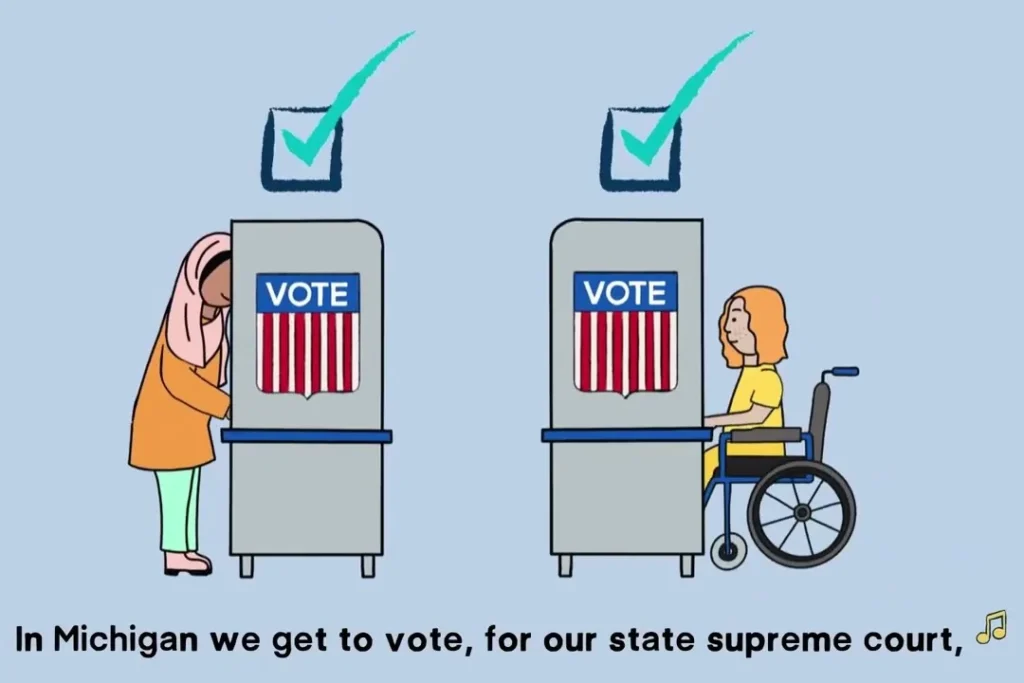
Illustration of two voters at voting machines, one using a wheelchair, with the caption: In Michigan we get to vote, for our state supreme court.

How a nonpartisan voter education campaign cut Supreme Court ballot roll-off by a third.

Client Engage Michigan · 2024
Partner Basis Technologies

The problem

In 2020, 5.5 million Michiganders voted for president. Only about 3.1 million of them voted in the state Supreme Court election — a drop-off of 2.4 million people. More than four in ten voters skipped the section entirely.

Some of that was ballot design. The nonpartisan section does not sit in the same place on every ballot — its position shifts by jurisdiction, so a voter cannot rely on habit or on where they saw it last time. Some of it was a misunderstanding: the state’s straight-ticket option covers most offices but not the nonpartisan Supreme Court races, and a great many voters assumed it did.

The result was two of the most consequential seats in Michigan government being decided by a fraction of the people who showed up to vote.

The approach

This was 501(c)(3) work — voter education, and nothing else. We used nonpartisan voter modeling to build the audience, and creative that never mentioned a candidate. We worked with Engage Michigan to get more people to vote their whole ballot.

That constraint shaped everything. This was not a persuasion problem and could not have been treated as one. Voters were not choosing the wrong candidate — they were not making a choice at all. So the work was built as a behavior campaign in three phases, timed to the way people actually encounter a ballot, and it ran for nearly five months rather than the last six weeks.

That timing was itself unusual. Michigan Supreme Court campaigns typically start late, and roughly half of a normal election budget goes out in the final 45 days. This one started in June, because the thing being taught — that there is a second section on the ballot and that straight-ticket voting does not cover it — takes longer to land than a candidate preference does.

Through the summer, ads led with civic values and a deliberately light touch, using trusted messengers and plain analogies. You wouldn’t half-bake a cake; don’t half-fill out your ballot. In mid-October, as ballots began arriving in mailboxes, the campaign switched to an animated singing eagle — an absurd image with a song engineered to lodge in your head, which is what it takes to cut through in the last three weeks of a presidential year. That spot ran through the closing two weeks and delivered 1.2 million impressions on its own. The final flight said the thing plainly: turn the ballot over and vote.

The buy

Between 75 and 80 percent of the media budget went to streaming and connected TV, placed through programmatic guaranteed and private marketplace deals — SSP partners including OpenX, Magnite and Equativ, publishers including Paramount and NBC/Universal, and device manufacturers including LG Ads and Samsung — alongside direct buys with Hulu and Roku. The remainder went to YouTube and Meta.

The audience was built from behavior, not from party. Ballots are secret, so no file will tell you which voters left a race blank; what the record does show is where it happened. The model worked from the precincts with the highest historical roll-off, layered with turnout propensity — people who reliably show up in presidential years — plus first-time college voters who would not yet know how a Michigan ballot is arranged.

That audience was roughly three percent of Michigan’s population, spread across a wide range of demographics and media markets. A broadcast buy built to reach them would have paid to reach the other ninety-seven percent too.

The results

Supreme Court roll-off fell from over 40 percent in 2020 to 25 percent in 2024 — a reduction of about a third. Hundreds of thousands of Michiganders who would have left the race blank filled it in instead.

Turnout in the race was high enough that local outlets could project the result shortly after polls closed. Michigan Supreme Court races are normally not called until late in the evening, once the slower-reporting counties come in. That is a small detail and a real one: it means enough people voted the full ballot to make the count decisive early.

The campaign delivered 7.2 million impressions on a budget under $700,000, through a summer when Olympic advertising had bid up inventory and an October when every other campaign in the country was competing for the same space.

Video completion ran 86.13 percent across the whole program, against an industry norm of 70 to 80 percent. On connected TV it reached 95 percent. On YouTube it reached 66 percent — more than double the 30 percent typical for political advertising.

What the client said

Working with WKQ Media has resulted in a trusted and strategic partnership that we can rely on even during the most challenging campaigns. Their team managed a wide variety of projects for us, all under tight deadlines and sometimes with unexpected and last-minute changes to budgets and timelines. They consistently delivered everything on time and on budget, showcasing their remarkable ability to adapt and execute efficiently.

Sam Inglot, Executive Director, Engage Michigan

Awards

Campaigns & Elections publishes winners only, so the finalist selection above has no public list to point at. Our full record, with every citation linked to the awarding body, is on the awards page.

170 Ads Per Student: Turning Out College Voters Against the Statewide Tide

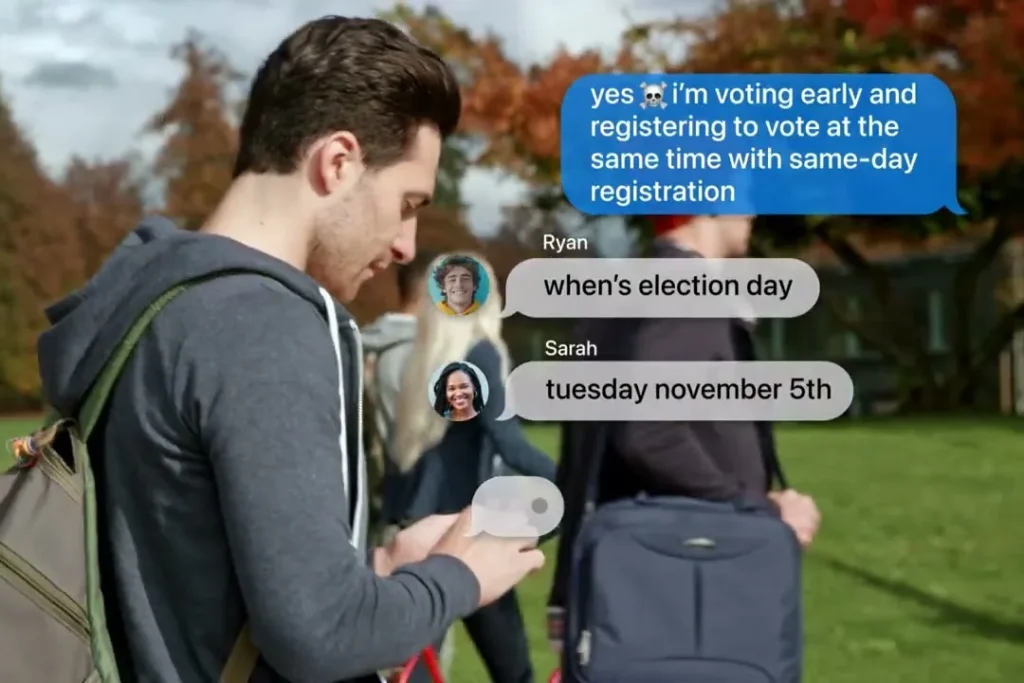
A college student on campus checks his phone, with text messages reading "when's election day" and "tuesday november 5th."

One audience, two sets of rules, and a college turnout program that ran against the statewide tide.

Clients For Michigan (501c3) · For Michigan Action Fund (501c4) · 2024

The problem

College students are the audience every campaign says it wants and almost none of them reach. They are mobile, they are not where their voter registration says they are, they do not watch television, and they are the single easiest group to buy badly.

There was a second problem underneath that one, and it is the more interesting half of this program.

Two entities, one audience

The work ran across For Michigan, a 501(c)(3), and For Michigan Action Fund, a 501(c)(4). Same students, same campuses, same media landscape — and two different sets of rules about what could be said to them and what data could be used to find them.

  • The C3 side could do voter education and turnout. No partisan data in the modeling, no candidates named.
  • The C4 side could use partisan data and argue about issues.

Most buyers treat this as a compliance headache to be survived. Run properly it is a structural advantage, because each entity can do the thing it is actually best placed to do, and — while keeping both campaigns distinct and well labeled — students experienced messages from both that built on each other. The C3 campaign encouraged students to vote; the C4 campaign educated them on the issues that affected them most.

The wall between them was real — separate targeting, separate creative, separate reporting, and separate media plans — while the messages complemented each other.

The approach

Saturation, in a tightly drawn box. Between September 1 and Election Day the program delivered 88.7 million ads across paid social, display, online video, streaming television, YouTube, college newspapers in print and online, and digital out-of-home — an average of roughly 170 exposures per student.

Targeting stacked geography, age and third-party data to concentrate on undergraduate and graduate students around Michigan’s major campuses.

Digital out-of-home did the work that voter-file targeting cannot. Students got reminders on the screens they pass anyway: bars, grocery stores, bus stops, the cafeteria. College newspapers worked the same problem from the other end. A campus paper has almost no wasted circulation — everyone reading it is already in the audience — and in print it reaches students who have opted out of being reachable anywhere else. The creative was built for the platform rather than adapted to it — vertical video shot with college-age speakers, in the format students already use to talk to each other, running on Snapchat against under-35 audiences in priority campus ZIP codes.

Turnout · connected TV

Action Fund · Snapchat, vertical

The results

Michigan as a whole moved 1.4 points toward Republicans in 2024. In the campus precincts this program targeted, it went the other way.

Turnout. Voting in the targeted precincts rose 9.4 percent against 2016.

The Action Fund program helped move net Democratic votes up 16.3 percent on 2020 and 12.7 percent on 2016 — measured as votes for the Democratic presidential nominee minus votes for Trump, across all three cycles. The Democratic presidential margin improved over 2016 on twelve of fourteen campuses.

In the final two weeks the Action Fund delivered more than 2.3 million vertical Snapchat videos to roughly half a million college students. In the targeted campus precincts, Slotkin’s margin ran over 14,500 votes ahead. Her statewide victory margin was about 20,000.

Awards

Our full record, with every citation linked to the awarding body, is on the awards page.