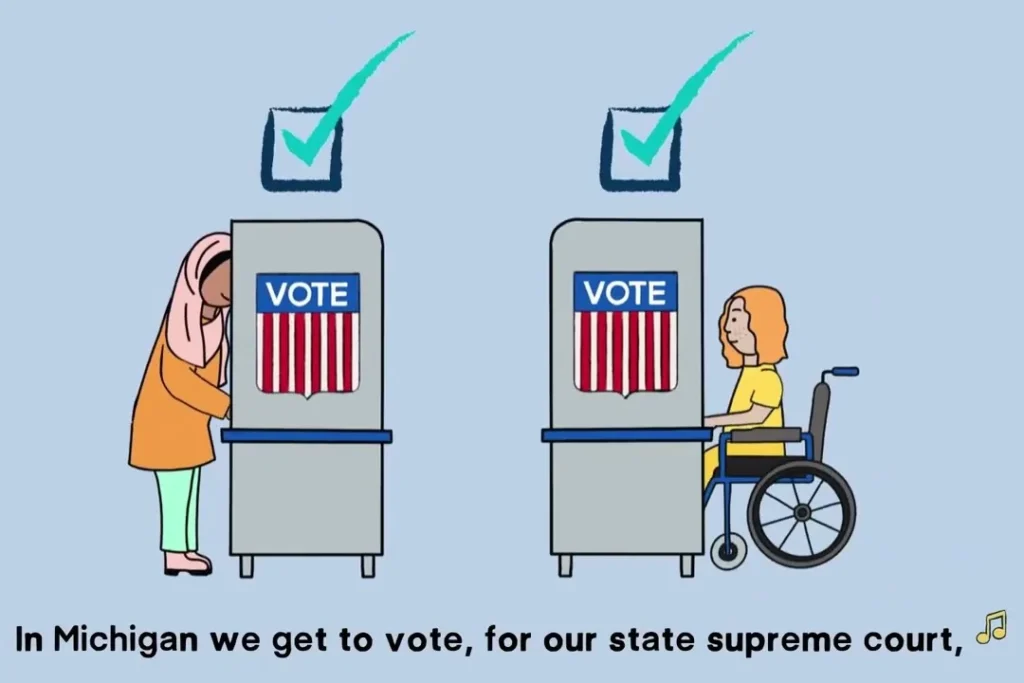
How a nonpartisan voter education campaign cut Supreme Court ballot roll-off by a third.
Client Engage Michigan · 2024
Partner Basis Technologies
The problem
In 2020, 5.5 million Michiganders voted for president. Only about 3.1 million of them voted in the state Supreme Court election — a drop-off of 2.4 million people. More than four in ten voters skipped the section entirely.
Some of that was ballot design. The nonpartisan section does not sit in the same place on every ballot — its position shifts by jurisdiction, so a voter cannot rely on habit or on where they saw it last time. Some of it was a misunderstanding: the state’s straight-ticket option covers most offices but not the nonpartisan Supreme Court races, and a great many voters assumed it did.
The result was two of the most consequential seats in Michigan government being decided by a fraction of the people who showed up to vote.
The approach
This was 501(c)(3) work — voter education, and nothing else. We used nonpartisan voter modeling to build the audience, and creative that never mentioned a candidate. We worked with Engage Michigan to get more people to vote their whole ballot.
That constraint shaped everything. This was not a persuasion problem and could not have been treated as one. Voters were not choosing the wrong candidate — they were not making a choice at all. So the work was built as a behavior campaign in three phases, timed to the way people actually encounter a ballot, and it ran for nearly five months rather than the last six weeks.
That timing was itself unusual. Michigan Supreme Court campaigns typically start late, and roughly half of a normal election budget goes out in the final 45 days. This one started in June, because the thing being taught — that there is a second section on the ballot and that straight-ticket voting does not cover it — takes longer to land than a candidate preference does.
Through the summer, ads led with civic values and a deliberately light touch, using trusted messengers and plain analogies. You wouldn’t half-bake a cake; don’t half-fill out your ballot. In mid-October, as ballots began arriving in mailboxes, the campaign switched to an animated singing eagle — an absurd image with a song engineered to lodge in your head, which is what it takes to cut through in the last three weeks of a presidential year. That spot ran through the closing two weeks and delivered 1.2 million impressions on its own. The final flight said the thing plainly: turn the ballot over and vote.
The buy
Between 75 and 80 percent of the media budget went to streaming and connected TV, placed through programmatic guaranteed and private marketplace deals — SSP partners including OpenX, Magnite and Equativ, publishers including Paramount and NBC/Universal, and device manufacturers including LG Ads and Samsung — alongside direct buys with Hulu and Roku. The remainder went to YouTube and Meta.
The audience was built from behavior, not from party. Ballots are secret, so no file will tell you which voters left a race blank; what the record does show is where it happened. The model worked from the precincts with the highest historical roll-off, layered with turnout propensity — people who reliably show up in presidential years — plus first-time college voters who would not yet know how a Michigan ballot is arranged.
That audience was roughly three percent of Michigan’s population, spread across a wide range of demographics and media markets. A broadcast buy built to reach them would have paid to reach the other ninety-seven percent too.
The results
Supreme Court roll-off fell from over 40 percent in 2020 to 25 percent in 2024 — a reduction of about a third. Hundreds of thousands of Michiganders who would have left the race blank filled it in instead.
Turnout in the race was high enough that local outlets could project the result shortly after polls closed. Michigan Supreme Court races are normally not called until late in the evening, once the slower-reporting counties come in. That is a small detail and a real one: it means enough people voted the full ballot to make the count decisive early.
The campaign delivered 7.2 million impressions on a budget under $700,000, through a summer when Olympic advertising had bid up inventory and an October when every other campaign in the country was competing for the same space.
Video completion ran 86.13 percent across the whole program, against an industry norm of 70 to 80 percent. On connected TV it reached 95 percent. On YouTube it reached 66 percent — more than double the 30 percent typical for political advertising.
What the client said
Working with WKQ Media has resulted in a trusted and strategic partnership that we can rely on even during the most challenging campaigns. Their team managed a wide variety of projects for us, all under tight deadlines and sometimes with unexpected and last-minute changes to budgets and timelines. They consistently delivered everything on time and on budget, showcasing their remarkable ability to adapt and execute efficiently.
Sam Inglot, Executive Director, Engage Michigan
Awards
- AdExchanger Award, 2025 — Best Data-Driven TV Campaign, with Basis Technologies and Engage Michigan · announced by Basis Technologies
- CampaignTech Gold, 2024 — Pioneering Use of Digital, credited to Engage Michigan, WKQ Media and Basis Technologies · 2024 winners list, Campaigns & Elections
- MediaPost OMMA Awards, 2025 — finalist, Online Marketing Excellence, Politics · announced by Basis Technologies
- Reed Award finalist, Best Online Video for Public Affairs or Issue Advocacy, State/Local
Campaigns & Elections publishes winners only, so the finalist selection above has no public list to point at. Our full record, with every citation linked to the awarding body, is on the awards page.