Their Phone Is Set to English: Three Ways to Deliver Ads in the Language People Actually Prefer

Their Phone Is Set to English: Three Ways to Deliver Ads in the Language People Actually Prefer

Colorful speech bubbles showing "hello" in multiple languages — Hola, Bonjour, Ciao, Olá, and greetings in Japanese and Chinese

Language settings, a voter-file model, or the content someone is already watching. Only two of them work, and they solve different problems.

By Bill Redding, CEO and Founder, WKQ Media

In August I sent an email to our data partner INTRVL about how we should deliver Spanish-language ads on two congressional programs we were about to launch. It kicked off a back-and-forth that laid out, more plainly than I have seen anywhere else, the different ways a media buyer can put a Spanish ad in front of a Spanish speaker. Here is what came out of it, along with what we have seen when we ran each one.

The default: device and in-app language settings

Most platforms’ language targeting works the same way. You pick “Spanish,” and the platform serves your ad to people whose device, browser, account or app is set to Spanish. Google’s Display & Video 360 documentation says as much — the targeting is based on the user’s language setting, which is why a Spanish speaker can see a Spanish ad on an English-language site.

The problem is who sets their device to Spanish. Pew Research Center’s work on language use among Latinos puts the picture in three rough buckets: about 36 percent bilingual, 25 percent mainly English, and 38 percent mainly Spanish. Roughly seven in ten U.S. Hispanics speak English fluently. Those voters bought their phones in English, set them up in English and left them that way. Device targeting finds the Spanish-dominant third and misses most of the rest, including bilingual voters who watch a great deal of Spanish-language television with a phone in their pocket that says otherwise. It also drifts: an account language changed after a trip, or a device synced from a relative, ends up assigning ads to the wrong person. It is a starting point, not a plan.

The model: language preference matched to the voter file

The second way is to stop asking the device and start asking the voter. On the New Jersey program we ran for Make the Road Action in 2025, INTRVL, working with DSPolitical, built a language model from thousands of digital surveys, then matched the modeled data to the voter file. The output was a named universe of voters who communicate in Spanish, scored individually and matched across connected TV, online video and social.

The model went one level further, into dialect. The word for the thing you drink through varies across the Spanish-speaking world — popote in Mexico, pajita across much of Latin America, sorbeto in Puerto Rico — and asking which word someone uses tells you which community they belong to, which tells you whose voice and accent should be in the ad. Creative was built for the community the model identified, not translated once and run everywhere.

Roughly a fifth of delivery ran in Spanish, with the English–Spanish split set by the model rather than fixed in advance. Measured against a 200,000-voter control group after the election, trust on immigration rose 8.1 points and trust on personal finances rose 8.9 among the voters we reached.

That is the most precise way to do this, and precision is worth paying for when the audience is small enough to saturate and the program will be measured. It carries a data fee on every impression, and a separate Spanish list is a smaller pool to bid into, which pushes CPMs up on its own. On one earlier set of districts a large share of the Spanish budget went to the data fee and increased CPM instead of more impressions.

The content: deliver in the language someone is already consuming

In Arizona this July we took a different approach from both. We worked with the Secretary of State’s advertising agency, RIESTER, to promote statewide BallotTrax signups. The program was nonpartisan, and had one job: get registered voters to sign up for ballot tracking. We used content and contextual flags on connected TV to serve the Spanish creative whenever a device was already viewing programming in Spanish — Telemundo’s World Cup coverage, Spanish-language streaming, Spanish-language news. The viewer told us their preference by pressing play. No data fee was paid to find them, so Spanish CPMs landed where the English CPMs landed.

Spanish creative featuring local soccer players and the Secretary’s own voice in Spanish ran from the first day of the flight and accounted for 13.9 percent of all delivery. Signups in the 13 counties the Secretary of State administers grew 84 percent across the flight window.

What content targeting cannot do is dialect. It knows the program is in Spanish; it does not know whether the household is Sonoran or Puerto Rican. In practice that matters less than it sounds. Producing creative for multiple dialects is time-consuming, and outside a handful of markets where several large Spanish-speaking communities sit side by side — New York, Miami, Los Angeles — one well-made Spanish spot serves the audience.

The same principle reaches languages no one has modeled. In a Michigan candidate program last cycle we needed Arabic and Hindi in the final week. Nobody builds a voter-file model for either, and almost no one in those communities has a device set to Arabic or Hindi. But YouTube lets you set the language of the creative itself, and it serves that creative to people consuming some of their content in that language. The campaign built Arabic and Hindi spots and we set each accordingly. People who watch part of their day in Arabic saw the ad in Arabic, even though their phone said English.

None of it works without the creative

Every one of these methods is a delivery mechanism, and a delivery mechanism cannot rescue a bad ad. Slapping an AI voice-over or a hurried dub in a second language onto the English spot does not move anyone. It reads as exactly what it is.

The creative has to be built from the ground up to speak to someone in English, Spanish, Arabic, Hindi or whatever they prefer — the messenger, the setting, the idiom, the accent. On the New Jersey program, where a message worked in both languages it was made twice, not translated. One spot ran only in Spanish and one only in English, because that is where each belonged. In Arizona the Spanish spots were their own spots, with separate video and VO of the Secretary explaining the importance of BallotTrax. That is what the delivery method is carrying, and it is the part that determines whether the number at the end moves.

Where this leaves a buyer

Device settings will find the Spanish-dominant voter and miss the bilingual one. A voter-file model will find both, at a cost, and can tell you which Spanish to speak. Content signals will find anyone consuming in a language, in any language a platform can flag, at no premium, without the dialect.

Most programs we run now use the last two together: the model where its precision is worth the fee, content and contextual delivery layered across the whole audience so that anyone watching in Spanish gets the Spanish ad whether or not the model flagged them. Either way, the goal is the same. Put the ad in the language a person actually prefers, even when their phone says English, and more of them watch it, click it, sign up, or come around.

If you are planning a program this fall with an audience that does not all speak English at home, I am at bill@wkq.media.

Popote, Pajita, Sorbeto: Communicating Across Languages in New Jersey

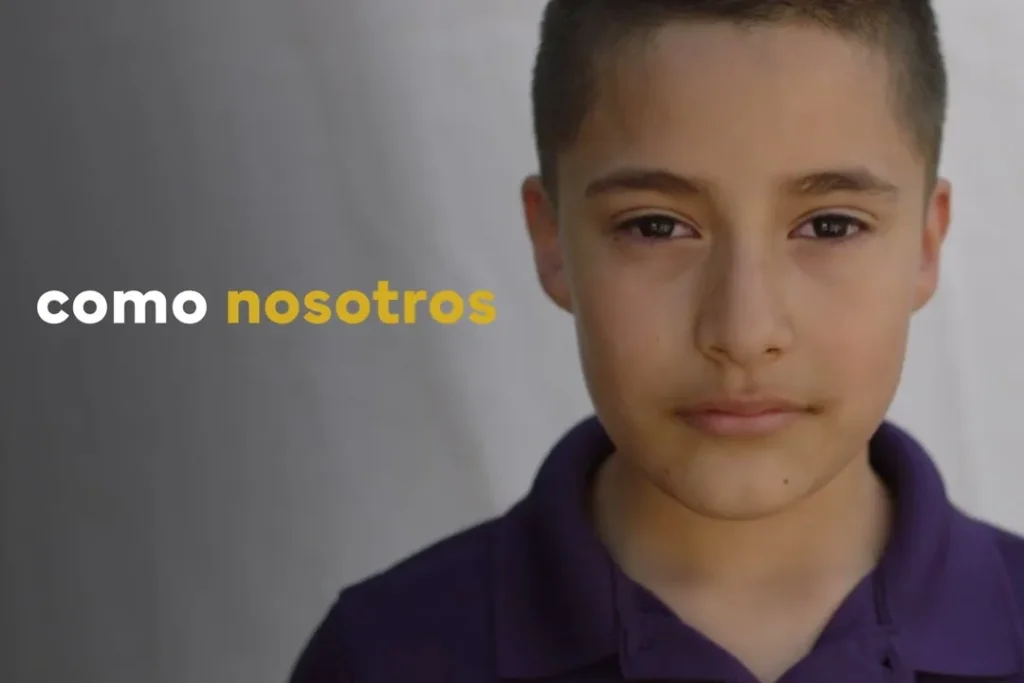
A boy in a purple shirt looks at camera, with the Spanish caption 'como nosotros'

What it takes to actually reach Latino voters — and how we proved it moved them.

Client Make the Road Action New Jersey · 2025
Partners Way to Win · INTRVL · creative by Moira Studio

The problem

Between 2020 and 2024, New Jersey’s presidential margin moved about ten points toward Republicans — from a 15.9-point Democratic win to a 5.9-point one. Democrats outspent Republicans two to one across that period. Whatever that money was buying, it was not reaching the people who moved.

For Latino-focused media the problem is sharper and more specific. As much as 70 percent of online ethnicity targeting misses. Surname targeting stopped working decades ago. Browser language settings are a crude proxy that misses most of the people they are meant to find. So campaigns spend real money on audiences that are substantially not who they think they are, and then draw conclusions from the results.

The approach

Two problems had to be solved at once: find the voters who could actually be moved, and reach them in the language they prefer.

This was a 501(c)(4) issue advocacy program. The advertising made a case about the economy and immigration — who holds responsibility for the cost of living, and who can be trusted on the issues these communities care about. It did not ask anyone to vote for or against a candidate.

Working with INTRVL, we built the audience from survey data rather than demographic assumption — scoring voters on INTRVL’s Mobisuasion model, which ranks people by whether they are both persuadable and mobilizable, then buying against that ranking rather than against a broad Latino segment. Roughly 85 percent of the audience sat in the top two Mobisuasion quintiles. Language preference was modeled the same way, from thousands of digital surveys, and matched at the individual level across connected TV, online video, and social.

Language preference is not a demographic checkbox. It is a behavior, tied to how people engage with culture, entertainment, and community — and voters who prefer Spanish-language content behave very differently from broad Hispanic segments assembled out of third-party data.

The model goes a level deeper than language, into dialect. The word for straw, the thing you drink through, varies across the Spanish-speaking world: popote in Mexico, from the Aztec; pajita across much of Latin America, from Spain; and sorbeto in Puerto Rico. Ask which word someone would use and you learn which community they belong to — which tells you which messenger to put in front of them, and in whose accent.

The buy

6.3 million impressions: 4.2 million on connected TV, 1.3 million on online video, 689,000 on social. Roughly a fifth of delivery ran in Spanish, with the English-Spanish split determined by the model and by what people were actually watching rather than fixed in advance. Seven creative variants. Average frequency of 31.4 across the flight — the audience was drawn small enough to saturate.

How we know it worked

This is the part most campaigns skip. Before the program launched, about 200,000 targeted voters were matched against an equivalent control group of 200,000 who were deliberately withheld from the buy, balanced on partisanship, turnout propensity, and movability. After the election, 5,571 survey responses were collected across two separate methods over 35 days.

That design is the difference between believing a program worked and being able to show it.

The results

The argument landed where it was aimed. Among targeted voters, agreement that the richest one percent bear more responsibility for the country’s problems rose 1.7 points. Trust on immigration rose 8.1 points, trust on personal finances 8.9, and Democratic Party favorability 5.5.

Those attitude shifts are the program’s own result — they measure whether the case being made was persuasive.

The survey also measured vote choice, which is the harder thing to move and was not what the advertising asked for. Within the targeted universe, support for the Democratic candidate rose 4.0 points and support for the Republican fell 3.1. Those move the margin in the same direction, so the gap between the two candidates widened by 7.1 points — from 22.5 points to 29.6. Across roughly 200,000 voters, that is a shift of about 14,000 votes. There is a 90 percent chance the true effect falls between 5.6 and 8.4 points, and better than 95 percent confidence the lift was positive.

Reported turnout rose a point overall and nearly two points among voters under 35.

The finding we did not expect: in-field results came in two to three times larger than the pre-campaign testing predicted — those ratios are for Like Us, the strongest performer in testing: 1.95x on personal finances, 1.98x on immigration trust, 2.75x on party favorability. The most likely reason is the targeting itself. Pretests measure a general population; this program only ever spoke to the half of the universe most capable of moving. Finding the movable voters before you spend the money changes what the money does.

The creative

Seven spots ran. Where a message worked in both languages it was made in both — not translated, but built twice, with the messenger and the accent chosen for the community the model had identified.

Soaring · English

Passaic · Spanish

Side · English

Lado · Spanish

Like Us · English

Como Nosotros · Spanish

One spot ran in English only. Break made an argument about what a federal budget bill costs a household, and the model put it where it landed hardest rather than translating it by default.

Break · English only

Awards

Campaigns & Elections publishes winners only, so the finalist selection above has no public list to point at. Our full record, with every citation linked to the awarding body, is on the awards page.

Digital Audio Ads: Reaching Audiences in a Noisy World

woman listening to podcast on her phone

Smart Sound Strategies: Using Digital Audio to Drive Campaign Impact

Navigating the complexities of digital audio advertising in the political sphere has been a formidable challenge for our agency. Despite substantial budgets and the medium’s rising prominence, we encountered significant obstacles that necessitated a strategic pivot to alternative inventory types, ultimately salvaging our campaign objectives.

Challenges in Digital Audio Advertising 

Our initial foray into digital audio was met with limited inventory availability. The scarcity of ad slots, coupled with intense competition, made it difficult to secure placements that aligned with our campaign timelines. Additionally, the lack of standardized measurement tools in digital audio hindered our ability to assess return on investment effectively. 

Strategic Pivot to Alternative Channels 

Recognizing these challenges, we redirected our focus to more accessible and measurable advertising channels: 

  • Programmatic Advertising: We leveraged programmatic platforms to automate media buying across various digital channels, enhancing efficiency and targeting precision. This approach allowed us to reach specific voter demographics with tailored messages, optimizing our ad spend. 
  • Social Media Campaigns: Utilizing platforms like Facebook, Twitter, and Instagram, we engaged with voters through interactive content and targeted ads. The robust analytics provided by these platforms enabled real-time performance tracking and campaign adjustments. 
  • Display and Native Advertising: We invested in display and native ads across high-traffic websites frequented by our target audience. This strategy ensured visibility and reinforced our campaign messages through consistent online presence. 

Here’s What Changed

By diversifying our advertising strategy, we achieved: 

  • Improved Reach and Engagement: The shift allowed us to connect with a broader audience, increasing voter engagement through multiple touchpoints. 
  • Enhanced Measurability: The alternative channels offered robust analytics, facilitating data-driven decisions and precise campaign optimization. 
  • Cost Efficiency: Diversifying our ad spend across various platforms mitigated the high costs associated with scarce digital audio inventory, ensuring a more efficient allocation of resources. 

Our agency’s ability to adapt to the challenges in digital audio advertising by pivoting to alternative inventory types was instrumental in achieving our campaign goals. This experience underscores the importance of flexibility and innovation in navigating the evolving landscape of political digital marketing. 

CTV Unlocked: Reaching Voters Where They Are

Innovative Advertising: Leveraging Connected TV (CTV) to Prioritize Our Client’s Campaigns

In the rapidly evolving world of digital marketing, Connected TV (CTV) has emerged as an invaluable tool for reaching engaged audiences. At our agency, we saw CTV not as an oversaturated market but as a promising, underutilized space where we could prioritize our client’s needs, securing impactful placements and building long-term value.

Why CTV?

CTV provides advertisers the opportunity to deliver targeted, high-quality ads directly to viewers through streaming platforms and smart TVs. With its expanding reach and the growing number of households using smart TVs, CTV offers access to a prime audience—without the saturation that often plagues other digital channels. Whether viewers are watching on their big glass screen at home or engaging with content through streaming services, CTV gives us the ability to reach them wherever they’re consuming TV content, in a more layered and strategic way.

Voters don’t know whether they’re on a FAST app, broadcast linear, or cable. We can reach them wherever they watch TV, and CTV enables us to do this across multiple layers and platforms, ensuring a seamless and comprehensive approach to targeting.

Rather than competing in a crowded space, we saw CTV as a market full of untapped potential for impactful, strategic advertising. The key to success in this area is ensuring our clients’ messages are consistently reaching the right people with the right level of exposure. That’s why we turned to programmatic guaranteed deals and Private Marketplace (PMP) deals to lock in premium placements and maximize both reach and frequency.

Programmatic Guaranteed Deals & PMPs: Securing Reach & Frequency

To ensure our client’s campaigns were delivered at the optimal cadence, we utilized programmatic guaranteed deals and PMPs. These agreements allowed us to secure highly targeted ad placements on major streaming platforms like Roku, Paramount, and Hulu. Our goal with these deals was to ensure that the right people saw our client’s message at the right frequency, delivering consistent visibility without oversaturation.

By locking in premium placements on these platforms, we could guarantee exposure to key audiences while controlling frequency to avoid overwhelming viewers. This strategic approach helped us strike the perfect balance between reach and repetition, ensuring our client’s message landed with the audience in a meaningful and impactful way. The result? A more effective advertising campaign that resonates without drowning in the clutter of linear and traditional ad formats.

Expanding Our Client’s Reach: Billboards & Gas Station TV Screens

Taking things further, we combined CTV placements with other out-of-home (OOH) strategies like digital billboards and gas station TV screens, integrating these into the larger media mix. This expanded the campaign’s reach, ensuring that the message was delivered in both digital environments and high-traffic physical locations, reinforcing brand visibility across diverse platforms.

Digital billboards and gas station screens allowed us to target commuters and drivers, extending the campaign beyond the home and into real-world settings. This omnichannel approach provided additional opportunities to keep the message top-of-mind, while reinforcing key points in environments where people are more likely to be receptive to external media—whether they are consuming content through CTV or more traditional linear ads.

The Impact of CTV for Our Clients

The result? A more effective and holistic advertising strategy that reached a wide range of engaged consumers. By focusing on a less saturated market like CTV, and strategically investing in programmatic guaranteed deals and PMPs, we ensured that our client’s message reached their target audience at just the right frequency and at the perfect moment. This helped prevent ad fatigue while maximizing the impact of every interaction.

Further bolstered by OOH tactics like billboards and gas station TV screens, this integrated approach allowed us to significantly amplify our client’s reach, keeping their messaging consistent and highly visible across multiple touchpoints. With CTV continuing to grow, advertisers have the opportunity to break free from the noise of linear TV and traditional digital ad spaces, making each campaign more personalized and impactful.

Connected TV offers a powerful advertising solution, particularly for clients looking to break through the noise of more crowded digital channels. By utilizing programmatic guaranteed deals, PMPs, and integrating OOH placements, we were able to prioritize our client’s campaign in a market that’s still ripe for exploration. As CTV continues to grow and evolve, staying ahead of the curve with strategic deals and placements will ensure we’re delivering maximum value to our clients, all while maintaining the right balance of reach and frequency. With big glass screens becoming more central to home viewing, now is the time to prioritize CTV in the media mix.

Turn the Ballot Over: Cutting Michigan Supreme Court Roll-Off by a Third

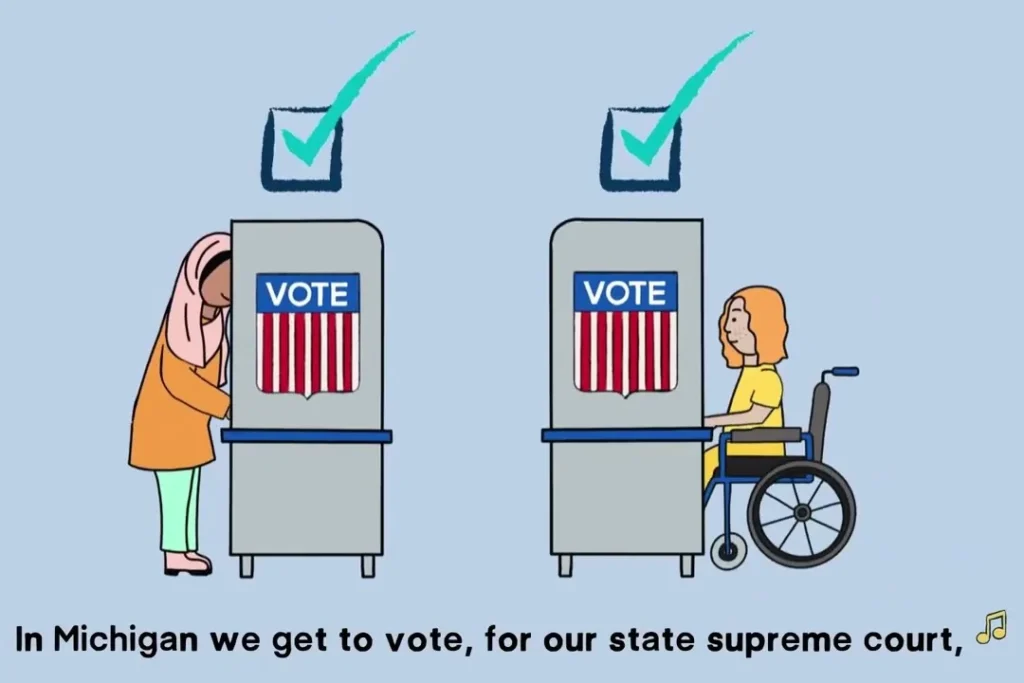
Illustration of two voters at voting machines, one using a wheelchair, with the caption: In Michigan we get to vote, for our state supreme court.

How a nonpartisan voter education campaign cut Supreme Court ballot roll-off by a third.

Client Engage Michigan · 2024
Partner Basis Technologies

The problem

In 2020, 5.5 million Michiganders voted for president. Only about 3.1 million of them voted in the state Supreme Court election — a drop-off of 2.4 million people. More than four in ten voters skipped the section entirely.

Some of that was ballot design. The nonpartisan section does not sit in the same place on every ballot — its position shifts by jurisdiction, so a voter cannot rely on habit or on where they saw it last time. Some of it was a misunderstanding: the state’s straight-ticket option covers most offices but not the nonpartisan Supreme Court races, and a great many voters assumed it did.

The result was two of the most consequential seats in Michigan government being decided by a fraction of the people who showed up to vote.

The approach

This was 501(c)(3) work — voter education, and nothing else. We used nonpartisan voter modeling to build the audience, and creative that never mentioned a candidate. We worked with Engage Michigan to get more people to vote their whole ballot.

That constraint shaped everything. This was not a persuasion problem and could not have been treated as one. Voters were not choosing the wrong candidate — they were not making a choice at all. So the work was built as a behavior campaign in three phases, timed to the way people actually encounter a ballot, and it ran for nearly five months rather than the last six weeks.

That timing was itself unusual. Michigan Supreme Court campaigns typically start late, and roughly half of a normal election budget goes out in the final 45 days. This one started in June, because the thing being taught — that there is a second section on the ballot and that straight-ticket voting does not cover it — takes longer to land than a candidate preference does.

Through the summer, ads led with civic values and a deliberately light touch, using trusted messengers and plain analogies. You wouldn’t half-bake a cake; don’t half-fill out your ballot. In mid-October, as ballots began arriving in mailboxes, the campaign switched to an animated singing eagle — an absurd image with a song engineered to lodge in your head, which is what it takes to cut through in the last three weeks of a presidential year. That spot ran through the closing two weeks and delivered 1.2 million impressions on its own. The final flight said the thing plainly: turn the ballot over and vote.

The buy

Between 75 and 80 percent of the media budget went to streaming and connected TV, placed through programmatic guaranteed and private marketplace deals — SSP partners including OpenX, Magnite and Equativ, publishers including Paramount and NBC/Universal, and device manufacturers including LG Ads and Samsung — alongside direct buys with Hulu and Roku. The remainder went to YouTube and Meta.

The audience was built from behavior, not from party. Ballots are secret, so no file will tell you which voters left a race blank; what the record does show is where it happened. The model worked from the precincts with the highest historical roll-off, layered with turnout propensity — people who reliably show up in presidential years — plus first-time college voters who would not yet know how a Michigan ballot is arranged.

That audience was roughly three percent of Michigan’s population, spread across a wide range of demographics and media markets. A broadcast buy built to reach them would have paid to reach the other ninety-seven percent too.

The results

Supreme Court roll-off fell from over 40 percent in 2020 to 25 percent in 2024 — a reduction of about a third. Hundreds of thousands of Michiganders who would have left the race blank filled it in instead.

Turnout in the race was high enough that local outlets could project the result shortly after polls closed. Michigan Supreme Court races are normally not called until late in the evening, once the slower-reporting counties come in. That is a small detail and a real one: it means enough people voted the full ballot to make the count decisive early.

The campaign delivered 7.2 million impressions on a budget under $700,000, through a summer when Olympic advertising had bid up inventory and an October when every other campaign in the country was competing for the same space.

Video completion ran 86.13 percent across the whole program, against an industry norm of 70 to 80 percent. On connected TV it reached 95 percent. On YouTube it reached 66 percent — more than double the 30 percent typical for political advertising.

What the client said

Working with WKQ Media has resulted in a trusted and strategic partnership that we can rely on even during the most challenging campaigns. Their team managed a wide variety of projects for us, all under tight deadlines and sometimes with unexpected and last-minute changes to budgets and timelines. They consistently delivered everything on time and on budget, showcasing their remarkable ability to adapt and execute efficiently.

Sam Inglot, Executive Director, Engage Michigan

Awards

Campaigns & Elections publishes winners only, so the finalist selection above has no public list to point at. Our full record, with every citation linked to the awarding body, is on the awards page.

170 Ads Per Student: Turning Out College Voters Against the Statewide Tide

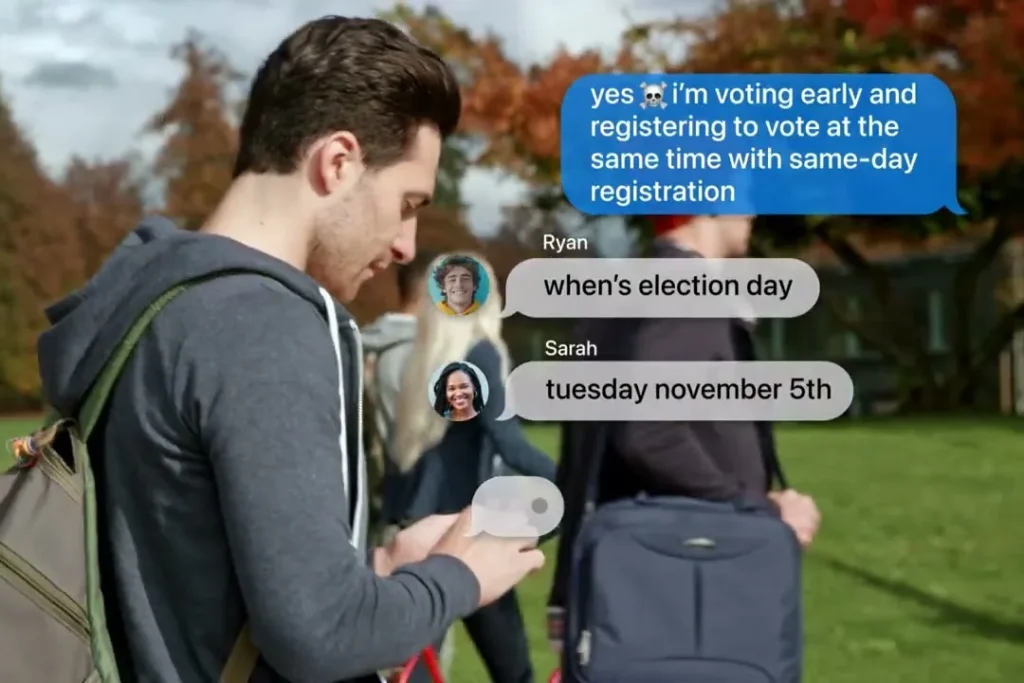
A college student on campus checks his phone, with text messages reading "when's election day" and "tuesday november 5th."

One audience, two sets of rules, and a college turnout program that ran against the statewide tide.

Clients For Michigan (501c3) · For Michigan Action Fund (501c4) · 2024

The problem

College students are the audience every campaign says it wants and almost none of them reach. They are mobile, they are not where their voter registration says they are, they do not watch television, and they are the single easiest group to buy badly.

There was a second problem underneath that one, and it is the more interesting half of this program.

Two entities, one audience

The work ran across For Michigan, a 501(c)(3), and For Michigan Action Fund, a 501(c)(4). Same students, same campuses, same media landscape — and two different sets of rules about what could be said to them and what data could be used to find them.

  • The C3 side could do voter education and turnout. No partisan data in the modeling, no candidates named.
  • The C4 side could use partisan data and argue about issues.

Most buyers treat this as a compliance headache to be survived. Run properly it is a structural advantage, because each entity can do the thing it is actually best placed to do, and — while keeping both campaigns distinct and well labeled — students experienced messages from both that built on each other. The C3 campaign encouraged students to vote; the C4 campaign educated them on the issues that affected them most.

The wall between them was real — separate targeting, separate creative, separate reporting, and separate media plans — while the messages complemented each other.

The approach

Saturation, in a tightly drawn box. Between September 1 and Election Day the program delivered 88.7 million ads across paid social, display, online video, streaming television, YouTube, college newspapers in print and online, and digital out-of-home — an average of roughly 170 exposures per student.

Targeting stacked geography, age and third-party data to concentrate on undergraduate and graduate students around Michigan’s major campuses.

Digital out-of-home did the work that voter-file targeting cannot. Students got reminders on the screens they pass anyway: bars, grocery stores, bus stops, the cafeteria. College newspapers worked the same problem from the other end. A campus paper has almost no wasted circulation — everyone reading it is already in the audience — and in print it reaches students who have opted out of being reachable anywhere else. The creative was built for the platform rather than adapted to it — vertical video shot with college-age speakers, in the format students already use to talk to each other, running on Snapchat against under-35 audiences in priority campus ZIP codes.

Turnout · connected TV

Action Fund · Snapchat, vertical

The results

Michigan as a whole moved 1.4 points toward Republicans in 2024. In the campus precincts this program targeted, it went the other way.

Turnout. Voting in the targeted precincts rose 9.4 percent against 2016.

The Action Fund program helped move net Democratic votes up 16.3 percent on 2020 and 12.7 percent on 2016 — measured as votes for the Democratic presidential nominee minus votes for Trump, across all three cycles. The Democratic presidential margin improved over 2016 on twelve of fourteen campuses.

In the final two weeks the Action Fund delivered more than 2.3 million vertical Snapchat videos to roughly half a million college students. In the targeted campus precincts, Slotkin’s margin ran over 14,500 votes ahead. Her statewide victory margin was about 20,000.

Awards

Our full record, with every citation linked to the awarding body, is on the awards page.

WKQ Media Adds Two Media Buyers: Michael O’Meara and Brianna Herrington

Many vintage televisions, stacked

WKQ Media added two media buyers to its team this summer. Michael O’Meara joins as SVP, Media Buying. Brianna Herrington joins as Media Buyer and Strategist.

Michael brings years of digital buying experience and deep Michigan roots to the role. Before WKQ, he managed statewide campaigns for the University of Michigan Board of Regents and the Michigan Supreme Court, ran public media relations for Macomb County, and built the digital media program for a Michigan law firm. At WKQ, he leads digital buying, optimizing inventory so clients get the most meaningful impressions for their budgets, and works with clients across the country to place buys across every channel.

Brianna is a graduate of Georgia State University, where she earned a degree in Public Health. She brings more than six years of paid media buying experience across e-commerce, healthcare and progressive politics, with particular strength in social platforms and programmatic buying. At WKQ, she’ll work with clients across the country to plan and place buys across every channel.

WKQ Media is a media buying desk for progressive campaigns and advocacy organizations, buying CTV, radio, linear, DOOH, programmatic and paid social. WKQ does not produce creative, which keeps its buying recommendations independent of production incentives.

How the 2024 Election is Redefining Media Buying in Political Campaigns

Hand reaching toward old television

As we steadily march towards the 2024 election season, we’re not just moving into another election year; we’re stepping into a realm of revolutionary change in the world of media buying for political campaigns. The landscape we once knew is undergoing a seismic shift, propelled by rapid technological advancements and a dynamic shift in consumer behaviors and preferences. In this era of constant digital evolution, the lines between digital and traditional media are not just blurring; they are being redrawn.

This year, we’re not just observers of change; we’re participants in a transformation that’s rewriting the rulebook on how political campaigns connect with voters. As experts and innovators in the field, we’re excited to share our insights and predictions on the major trends that will define media buying in 2024:

  • Digital-First, But Not Digital-Only Strategies: The rise of digital media is undeniable, but 2024 will highlight a more nuanced approach. Expect to see campaigns adopting a digital-first strategy, yet skillfully integrating traditional media for a comprehensive reach.
  • Hyper-Personalized Voter Engagement: With advancements in AI and data analytics, campaigns will be able to deliver hyper-personalized content, targeting voters with precision accuracy, based on their behaviors, preferences, and even sentiment.
  • The Emergence of New Media Platforms: Beyond the usual suspects, new media platforms are set to emerge, offering innovative ways to reach and engage with younger, more technologically savvy voters.
  • The Power of Video Content: Video content, especially short-form, will dominate, driven by its proven effectiveness in capturing attention and conveying messages in a compelling and digestible format.
  • Mobile Optimization as a Necessity: In a world where smartphones are ubiquitous, optimizing content for mobile devices will no longer be optional. Campaigns will need to ensure that all digital content is mobile-friendly.
  • The Integration of Augmented Reality (AR) and Virtual Reality (VR): These technologies will start moving from the fringes to the forefront, offering immersive experiences that could revolutionize campaign storytelling and voter engagement.
  • Greater Emphasis on Analytics and ROI: Data won’t just inform strategies; it will drive them. Campaigns will place a greater emphasis on analytics and ROI, ensuring that every dollar spent is an investment towards a more engaged and motivated voter base.
  • Ethical Considerations and Transparency in Data Use: As data becomes more central to campaign strategies, ethical use of this data and transparency with voters about how their information is being used will become critical.
  • Real-Time Adaptation and Responsive Campaigns: The ability to adapt and respond in real-time to changing voter sentiments and news cycles will be crucial. Campaigns will need to be agile, adjusting strategies swiftly to stay relevant and effective.

As we plan for the 2024 election, it’s essential to understand that we are not just adapting to changes; we are at the forefront of a new era in political campaigning. By embracing these trends and harnessing their potential, political campaigns can create a more engaged, informed, and motivated electorate, leading to a healthier, more vibrant democratic process.

Veteran digital campaign strategist Bill Redding launches WKQ Media

Many vintage televisions, stacked

Digital ad buying agency launches with extensive knowledge of the latest trends in digital campaign strategy and advertising technology to help progressive and pro-worker digital content creators cut through the noise and meet target audiences where they are.

WASHINGTON, D.C. – In the lead up to the 2024 elections, veteran digital campaign strategist Bill Redding announced the launch of WKQ Media. Leveraging Redding’s more than two decades of experience in digital media and political organizing, the new digital ad buying agency designs customized media plans and executes cross platform digital advertising campaigns for Democratic and progressive media agencies and organizations across the country. WKQ’s team of digital media experts collaborate with advertising partners to map the complex and crowded digital advertising landscape to ensure their content reaches and resonates with its intended audience. 

Specializing in video-first campaigns — including OTT (over-the-top), CTV (connected TV), Addressable Cable, AVO (advertising-based video on demand), SVOD (subscription video on demand), and TVOD (transactional video on demand) — WKQ Media’s expertise spans the full spectrum of advertising delivery technologies.

“The digital advertising landscape continues to shift dramatically year after year. To win elections and achieve other organizational goals, it’s important for progressive and pro-worker creative advertising agencies and organizations to stay ahead of the trends, harness the power of data, and embrace new and emerging technologies,” said WKQ Media Founder Bill Redding. “Through our data-driven approach, we work to boost audience persuasion and engagement, achieving desired outcomes by crafting expert, data-informed digital media plans.”

With more than 20 years of experience at the intersection of traditional and digital media, Redding has run successful advocacy, union organizing, and political persuasion campaigns for labor unions, national non-profit organizations, and candidates up and down the ballot.    

“With Bill’s help over the past decade, we have been able to effectively communicate with both our members and other older Americans,” said Richard Fiesta, Executive Director of the Alliance for Retired Americans, a grassroots advocacy organization with 4.4 million members across the country. “Retirees are active and engaged but one size does not fit all. Bill has helped us tailor and execute plans to meet seniors where they are and deliver information about issues that affect their lives.”

A resource for reporters:
In addition to working with clients, Redding and WKQ Media will serve as a source and a resource for reporters seeking to deepen their knowledge of the paid digital media and advertising industry and the application of digital strategy and tactics in campaigns and elections. 

“With the 2024 elections fast approaching, reporters covering political campaigns, digital marketing, and technology need to stay on top of the latest trends in a constantly evolving digital advertising landscape,” said Grace Briscoe, SVP of Client Development at Basis Technologies. “Bill and WKQ media have the expertise and road-tested experience to help journalists navigate this chaotic and faced-paced environment.”

###

WKQ Media are digital media buyers. We work with you and your clients to design and deliver effective, data-driven digital media plans.