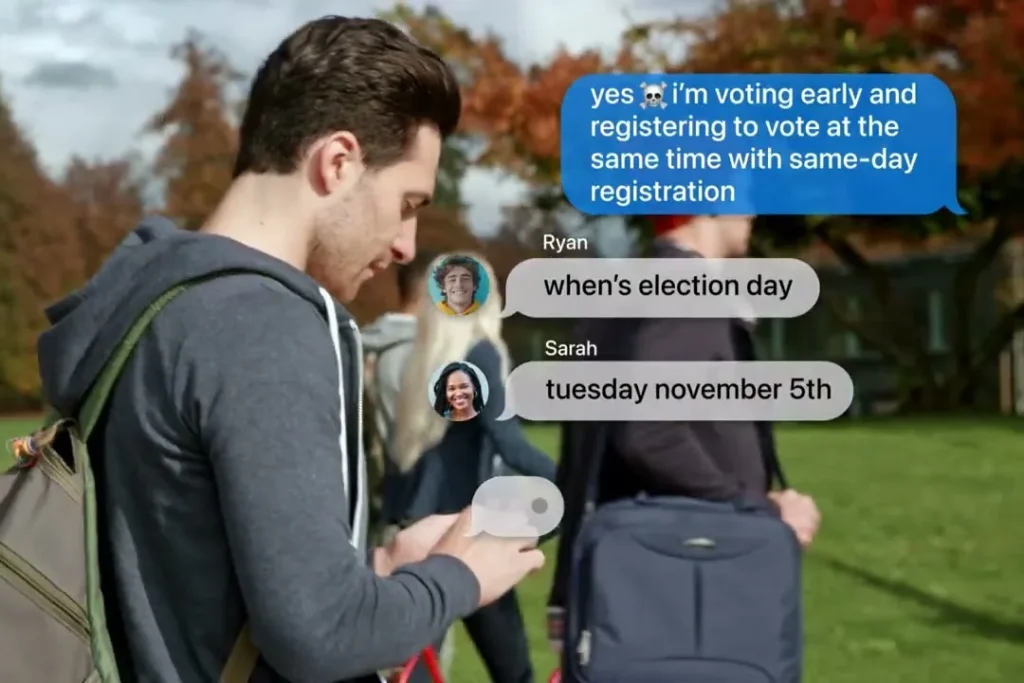
One audience, two sets of rules, and a college turnout program that ran against the statewide tide.
Clients For Michigan (501c3) · For Michigan Action Fund (501c4) · 2024
The problem
College students are the audience every campaign says it wants and almost none of them reach. They are mobile, they are not where their voter registration says they are, they do not watch television, and they are the single easiest group to buy badly.
There was a second problem underneath that one, and it is the more interesting half of this program.
Two entities, one audience
The work ran across For Michigan, a 501(c)(3), and For Michigan Action Fund, a 501(c)(4). Same students, same campuses, same media landscape — and two different sets of rules about what could be said to them and what data could be used to find them.
- The C3 side could do voter education and turnout. No partisan data in the modeling, no candidates named.
- The C4 side could use partisan data and argue about issues.
Most buyers treat this as a compliance headache to be survived. Run properly it is a structural advantage, because each entity can do the thing it is actually best placed to do, and — while keeping both campaigns distinct and well labeled — students experienced messages from both that built on each other. The C3 campaign encouraged students to vote; the C4 campaign educated them on the issues that affected them most.
The wall between them was real — separate targeting, separate creative, separate reporting, and separate media plans — while the messages complemented each other.
The approach
Saturation, in a tightly drawn box. Between September 1 and Election Day the program delivered 88.7 million ads across paid social, display, online video, streaming television, YouTube, college newspapers in print and online, and digital out-of-home — an average of roughly 170 exposures per student.
Targeting stacked geography, age and third-party data to concentrate on undergraduate and graduate students around Michigan’s major campuses.
Digital out-of-home did the work that voter-file targeting cannot. Students got reminders on the screens they pass anyway: bars, grocery stores, bus stops, the cafeteria. College newspapers worked the same problem from the other end. A campus paper has almost no wasted circulation — everyone reading it is already in the audience — and in print it reaches students who have opted out of being reachable anywhere else. The creative was built for the platform rather than adapted to it — vertical video shot with college-age speakers, in the format students already use to talk to each other, running on Snapchat against under-35 audiences in priority campus ZIP codes.
Turnout · connected TV
Action Fund · Snapchat, vertical
The results
Michigan as a whole moved 1.4 points toward Republicans in 2024. In the campus precincts this program targeted, it went the other way.
Turnout. Voting in the targeted precincts rose 9.4 percent against 2016.
The Action Fund program helped move net Democratic votes up 16.3 percent on 2020 and 12.7 percent on 2016 — measured as votes for the Democratic presidential nominee minus votes for Trump, across all three cycles. The Democratic presidential margin improved over 2016 on twelve of fourteen campuses.
In the final two weeks the Action Fund delivered more than 2.3 million vertical Snapchat videos to roughly half a million college students. In the targeted campus precincts, Slotkin’s margin ran over 14,500 votes ahead. Her statewide victory margin was about 20,000.
Awards
- Reed Award, 2025 — Best Use of a Social Platform (Democratic), Michigan US Senate — Elissa Slotkin, with For Michigan Action Fund · 2025 winners list, Campaigns & Elections
Our full record, with every citation linked to the awarding body, is on the awards page.